
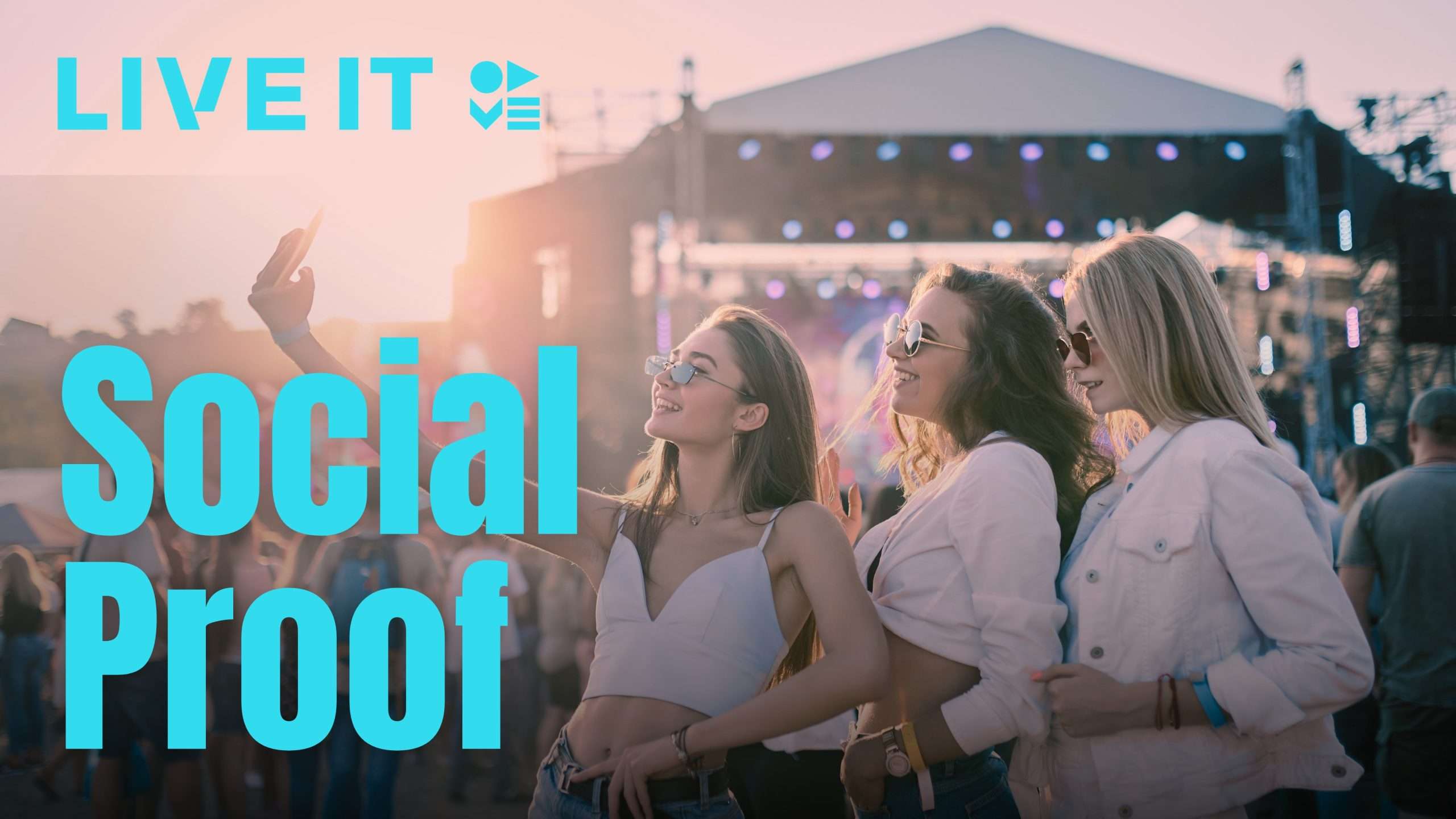
You’ve written the copy. You’ve set up the event page. You’ve run the ads. And yet, a significant portion of your potential audience is still sitting on the fence, waiting for something to tip them over. More often than not, that something isn’t another promotional email from you. It’s a photo from a stranger on Instagram, a five-star review from a past attendee, or a friend’s casual comment that they’re going.
This is the reality of modern consumer behaviour, and it has profound implications for how event organisers should think about their marketing. According to the Nielsen Global Trust in Advertising Report, 92% of consumers trust peer recommendations over any other form of advertising. A separate 2026 Clutch report found that 96% of consumers check online reviews before making a first-time purchase. In the context of events where the product is an experience that can’t be returned, that instinct to seek outside validation is even stronger.
The good news is that this dynamic doesn’t work against you. It works for you, if you know how to harness it. Your past attendees are your most credible marketing channel. The question is whether you’re treating them like one.
What Social Proof Actually Is (And Isn’t)
The term “social proof” was coined by psychologist Robert Cialdini in his landmark 1984 book Influence, describing the human tendency to look to others’ behaviour when making decisions under uncertainty. In a marketing context, it has come to encompass a broad range of signals: reviews, testimonials, star ratings, attendee counts, user-generated content (UGC), influencer endorsements, and even the visible enthusiasm of a crowd.
What social proof is not, is a shortcut or a gimmick. Fake reviews, inflated attendance figures, and manufactured testimonials are not only ethically problematic, they are increasingly easy for audiences to detect, and the reputational damage when they are exposed is severe. The power of social proof lies entirely in its authenticity. A single genuine, specific review from a real attendee will outperform a dozen polished brand statements every time.
For event organisers, this means the work of building social proof begins long before your next campaign launches. It begins at your last event.
The Five Forms of Social Proof That Move Tickets
Not all social proof is created equal. Understanding the different types and where each one is most effective, allows you to deploy them strategically rather than scattering them indiscriminately.
Type of Social Proof | What It Looks Like | Where It Works Best |
Attendee Reviews & Ratings | Star ratings and written feedback on event pages or third-party platforms | Event listing pages, email campaigns, Google |
User-Generated Content (UGC) | Photos, videos, and social posts created by attendees | Social media, event pages, paid ads |
Peer Sharing & RSVPs | Visible signals that people in a prospect’s network are attending | Facebook Events, LinkedIn, email |
Testimonials & Case Studies | Direct quotes or stories about the value gained from attending | Landing pages, email nurture sequences, social media |
Crowd & Momentum Signals | Ticket sales counters, “X people are viewing this event”, sold-out notices | Ticketing pages, remarketing campaigns |
Research from the tourism and live events sector shows that conversion rates increase by an average of 161% when an event or product page includes photos or videos from real customers. That figure alone should reframe how you think about post-event content collection.
The Timing Problem Most Organisers Get Wrong
The most common mistake event organisers make with social proof is treating it as an afterthought – something to collect “when there’s time” after the event has wrapped and the team has moved on to the next project. By then, the window has largely closed.
Attendee enthusiasm is highest in the 24 to 48 hours immediately following an event. This is when memories are vivid, emotions are still elevated, and people are most likely to share, review, and recommend. SurveyMonkey’s research on post-event feedback confirms that sending a review request within one business day of an event yields significantly higher response rates than waiting longer.
A practical approach is to build a three-stage review and UGC collection sequence into every event’s post-production workflow:
Stage 1 — During the event: Create natural moments for attendees to share. A branded hashtag, a “leave your review” QR code, a photo opportunity with good lighting and clear signage, or a simple prompt from the stage (“If you’ve enjoyed today, we’d love you to share it”) can generate a wave of organic content in real time. This content serves double duty: it reaches the networks of your existing attendees and gives you a library of authentic material to repurpose.
Stage 2 — Within 48 hours: Send a short, personalised follow-up email thanking attendees and asking for a review. Keep the ask specific and low-friction – a direct link to your review platform, a single open-ended question (“What was the highlight of the event for you?”), and a clear explanation of why their feedback matters. Avoid sending a lengthy survey at this stage; that can come later. The goal here is to capture sentiment while it’s warm.
Stage 3 — One to two weeks later: Follow up with attendees who didn’t respond to the first request, and use this touchpoint to ask for longer-form testimonials or case studies from those who did. This is also the right moment to request permission to use any UGC they created, and to share a curated selection of highlights back to the community, reinforcing the positive experience and keeping the conversation alive.
LIVE IT’s partnership with Fast Review becomes a practical game-changer. Fast Review combines branded NFC-enabled cards with a lightweight software platform: an attendee simply taps their phone on the card and, within seconds, they are directed straight to your Google review page – no searching, no friction, no forgetting to do it later. The whole process takes under ten seconds, capturing sentiment at exactly the right moment: on-site, while the experience is still live.
LIVE IT organisers can deploy Fast Review cards at exits, box offices, or staffed points throughout the venue, turning the natural post-experience buzz into a steady stream of verified public reviews.
The results speak for themselves. The organiser behind the Queen’s House ice rink in Greenwich used Fast Review through LIVE IT and achieved a 4.5 Google rating – placing it among the highest-rated attractions in London. At Skate Manchester, the same approach delivered a 4.9 Google rating, widely considered to be among the highest of any ice rink in the UK. These are not just vanity metrics; ratings at that level directly influence whether a first-time visitor chooses your event over a competitor, and they compound over time as each new season of reviews builds on the last.
Turning Reviews Into a Sales Asset
Collecting reviews is only half the equation. The other half is deploying them where they will have the greatest impact on conversion. Many organisers gather positive feedback and then leave it buried in a post-event survey report that no one outside the team ever reads. That is a significant missed opportunity.
Here is where social proof belongs in your marketing ecosystem:
On your event page. The moment a prospective attendee lands on your event listing, they are looking for reasons to trust you. A prominently displayed star rating, two or three short testimonials from past attendees, and a gallery of real event photos from previous editions will do more to build that trust than any amount of promotional copy. The anatomy of a high-converting event page is built on credibility — and nothing establishes credibility faster than the voice of someone who has already been there.
In your email campaigns. Rather than leading with features (“Three stages, 40 speakers, networking lunch included”), lead with outcomes expressed in the words of past attendees. A subject line like “Here’s what people said about last year’s event” will consistently outperform a feature-led equivalent, because it shifts the frame from what you’re offering to what others have experienced.
In your paid social advertising. UGC-style creative – whether genuine attendee content or content produced to feel authentic — consistently outperforms polished brand advertising in social media environments. This is partly because it blends more naturally into the feed, and partly because audiences have become adept at filtering out content that feels like an ad. A short video clip of an attendee describing what they got from your event, shot on a phone, will often outperform a professionally produced promotional video.
In remarketing campaigns. Prospective attendees who have visited your event page but not yet purchased are among your highest-value audiences. Serving them a remarketing ad that features a specific, relatable testimonial rather than a generic “Book now” message, addresses the hesitation that stopped them converting in the first place.
Making It Easy for Your Community to Sell for You
The most sustainable social proof strategy is one that builds a community of advocates who share naturally, because they feel genuinely connected to what you create. This means investing in the attendee experience itself not just as a product, but as a community. When people feel that an event is theirs, that they are part of something, they talk about it unprompted. They post about it. They bring friends. They come back.
Practically, this looks like: creating spaces (physical and digital) where attendees can connect with each other, not just with you; acknowledging and amplifying the content your community creates rather than only sharing your own; building a pre-event community that generates anticipation and peer-to-peer conversation before the doors even open; and treating your most loyal attendees as collaborators – involving them in shaping future events, giving them early access, and making them feel seen.
The organisers who do this well find that their social proof largely takes care of itself. The reviews come in without prompting. The UGC flows without a hashtag campaign. The word-of-mouth spreads without a referral scheme. That is not magic, it is the compound return on consistently delivering experiences that people genuinely want to talk about.
A Note on Transparency
One final point, and it connects directly to the conversation our blog has explored previously around ticketing fees and buyer trust. Social proof only works when it is honest. Selectively displaying only five-star reviews, removing negative feedback, or presenting testimonials out of context will eventually erode the trust you are trying to build. Audiences are sophisticated, and a page with nothing but glowing praise can feel as suspicious as one with no reviews at all.
The most credible approach is to show the full picture – a strong average rating that includes a range of scores, responses to critical feedback that demonstrate you listen and improve, and testimonials that are specific and believable rather than vague and superlative. Trust is built not by appearing perfect, but by appearing honest.
The Takeaway
Your marketing budget, your copywriting, and your ad targeting all matter. But none of them carry the weight of a genuine recommendation from someone who has already experienced what you offer. The event organisers who consistently sell out are not necessarily the ones with the biggest budgets – they are the ones who have built a community of advocates and given those advocates the tools and the moments to share.
Start with your last event. Find the people who loved it. Ask them to tell you why. Then put their words where your next audience can find them.
That is how you turn your community into your best sales team.
Event Planning Tips & Tricks:
Get advice, ideas, and inspiration for your next event and take your planning, marketing, and ticketing game to the next level.
LIVE IT × Lightspeed: When Ticketing Meets EPOS
When you're running a venue, attraction, or festival, the gap between your ticketing system and your point-of-sale is more than just a technical inconvenience. It's missed revenue, fragmented data, and hours of manual reconciliation that nobody signed up for. That's...
Scaling Smarter: 6 Powerful New LIVE IT Features Designed to Simplify Event Operations
In the world of event management, operational efficiency and attendee satisfaction are the twin engines of growth. Every manual support ticket resolved and every minute saved in event setup directly impacts your bottom line. In fact, research shows that event...
Wales Rugby League Announce LIVE IT as Their Official Ticketing Partner
Wales & Edinburgh, Scotland, 17 June 2026 – LIVE IT Ticketing and Wales Rugby League (WRL), the national governing body for rugby league in Wales, are pleased to jointly announce their official ticketing partnership. Under the agreement, LIVE IT Ticketing becomes...
Feature Focus:
Take a deep dive into the features that make our ticketing platform so well-loved by organisers and learn how best to use them.
LIVE IT × Lightspeed: When Ticketing Meets EPOS
When you're running a venue, attraction, or festival, the gap between your ticketing system and your point-of-sale is more than just a technical inconvenience. It's missed revenue, fragmented data, and hours of manual reconciliation that nobody signed up for. That's...
Scaling Smarter: 6 Powerful New LIVE IT Features Designed to Simplify Event Operations
In the world of event management, operational efficiency and attendee satisfaction are the twin engines of growth. Every manual support ticket resolved and every minute saved in event setup directly impacts your bottom line. In fact, research shows that event...

NEW FEATURE ALERT: Introducing LIVE IT’s Exclusive Access Booking
Revolutionize your events in 2024 with these impactful resolutions. Elevate experiences and stay inspired.